


Stucco Remediation Wilmington DE: Complete Homeowner Guide in Delaware
Stucco Remediation Wilmington DE: Complete Homeowner Guide in Delaware
Stucco and EIFS failures in Delaware homes typically stem from improperly installed flashing, not the cladding itself. LePore Stucco Services LLC, a third-generation family-owned firm, serves New Castle County homeowners in Wilmington, Hockessin, and Newark. The company is Moisture Free Certified and backs its repairs with Moisture Free Warranty options, bringing decades of hands-on experience to every project. It targets moisture intrusion at windows, doors, and roof intersections, avoiding unnecessary full tear-offs.
Key Takeaways
Stucco failures in Delaware homes rarely start with the cladding itself.
Missing, undersized, or improperly installed flashing causes most water intrusion issues.
Most homeowners in EIFS damage cases believed their homes had traditional stucco.
Full exterior tear-offs are rarely necessary; targeted flashing repairs stop moisture at its source.
LePore Stucco Services LLC is Moisture Free Certified and backs repairs with Moisture Free Warranty options, reflecting decades of hands-on family-owned expertise.
Why Does Stucco Fail in Delaware Homes?
Stucco failure in Delaware homes rarely starts with the stucco itself. The real culprit is almost always water intrusion at flashing points and material transitions. Homeowners who ignore early warning signs risk structural rot behind intact-looking walls.
Many Delaware homeowners do not actually know what cladding covers their houses. Stark & Stark reports that most homeowners in EIFS damage cases believed their homes had traditional stucco. That misunderstanding matters because synthetic systems fail differently than hard-coat stucco.
What Is the Difference Between Traditional Stucco and EIFS?
Traditional hard-coat stucco is extremely strong and durable. It essentially covers a home with a layer of rock made from sand, lime, Portland cement, and water. EIFS, by contrast, is a synthetic system with different failure modes.
EIFS was developed in Europe in the 1950s and introduced to the United States in the late 1960s, according to HomeKey Inspections. The material became a popular residential cladding choice by the mid-1990s. Homes built in New Castle County during that era may carry EIFS without the owner's knowledge.
Why Does Flashing Matter More Than the Stucco Surface?
Most water intrusion issues are caused by missing, undersized, or improperly installed flashing. Unsealed transitions where different exterior materials meet create the same problem. The stucco surface itself is rarely the source of failure.
LePore Stucco Services LLC addresses why stucco fails by targeting these installation details rather than replacing intact cladding. A delaware stucco moisture testing assessment identifies whether water has already penetrated the building envelope. An EIFS inspection confirms which cladding system is present before any repair plan begins.
For homeowners facing stucco remediation wilmington de or stucco repair new castle county, the first step is accurate diagnosis. Knowing whether the home has traditional stucco or EIFS determines the correct repair approach. Skipping that step leads to repeated failures and escalating damage.
What Should a Delaware Moisture Test Include?
A proper delaware stucco moisture testing process targets the real sources of water intrusion, not just surface stains. Homeowners in New Castle County often receive inspection reports that need professional review before any repair plan takes shape. LePore Stucco Services LLC reviews stucco and moisture intrusion reports to develop a clear, cost-effective plan tailored to each home.
The evaluation must focus on roof-to-wall intersections, window and door openings, and penetrations. These transition points are where water bypasses the cladding and damages the structure behind it. A visual check alone misses what hides inside the wall cavity.
What Areas Should a Delaware Moisture Test Cover?
Roof-to-wall intersections and kick-out flashing details
Window and door openings, including pan flashing and sill transitions
Deck, chimney, and utility penetrations
Foundation transitions where stucco meets grade
How Does an EIFS Inspection Differ from a Stucco Check?
An EIFS inspection should first determine whether the cladding is synthetic or traditional hard-coat stucco. The two systems require different evaluation criteria. Many homeowners do not know what to look for, which is why professional identification matters before any testing begins.
EIFS homes built in the 1990s and early 2000s have been widely reported to have serious moisture issues. Wilmington and Newark properties from that era warrant particular attention. A thorough stucco inspection documents what the eye cannot see.
For stucco repair new castle county homeowners, the report becomes the roadmap. LePore Stucco Services LLC translates findings into prioritized, surgical repairs that stop moisture at its source.
How Do You Fix Stucco Without a Full Tear-Off?
Many homeowners are told a full exterior tear-off is the only option when stucco shows signs of failure. In most cases, that recommendation is unnecessary. Stucco remediation Wilmington DE services can stop moisture at the source without demolition. The real culprit is usually faulty flashing, not surface damage.
LePore Stucco Services LLC provides targeted, cost-effective repairs that address the actual cause of water intrusion. The company fixes flashing details at windows, doors, rooflines, and foundation transitions. This approach preserves the home's structure while eliminating the moisture pathway.
What Does Targeted Stucco Repair Involve?
A targeted repair focuses on the specific points where water enters the building envelope. The process includes:
Inspecting and correcting flashing at roof-to-wall intersections
Sealing window and door openings properly
Addressing foundation transitions where water collects
Removing only damaged stucco sections, not entire walls
Stucco repair New Castle County projects should address faulty flashing rather than applying temporary surface patches. Surface patches mask symptoms while water continues damaging the structure behind the cladding.
Is Full Stucco Removal Ever Necessary?
In the company's experience, it is rare that all stucco needs to be removed. Homeowners should seek a second opinion before committing to a full replacement. A targeted stucco repair approach often resolves the issue at a fraction of the cost.
Delaware stucco moisture testing identifies exactly where water penetrates the assembly. That data guides surgical repairs instead of wholesale removal. EIFS inspection findings frequently point to isolated flashing failures, not systemic cladding failure.
What Else Does LePore Stucco Services Handle Beyond Flashing Repair?
LePore Stucco Services LLC's expertise extends past flashing corrections into the full range of exterior water management. The company is Moisture Free Certified and offers warranty options through Moisture Free Warranty, giving New Castle County homeowners a documented, verifiable outcome rather than a guess.
The firm's service scope includes:
Stucco remediation and repair, from isolated flashing fixes to larger moisture-driven projects
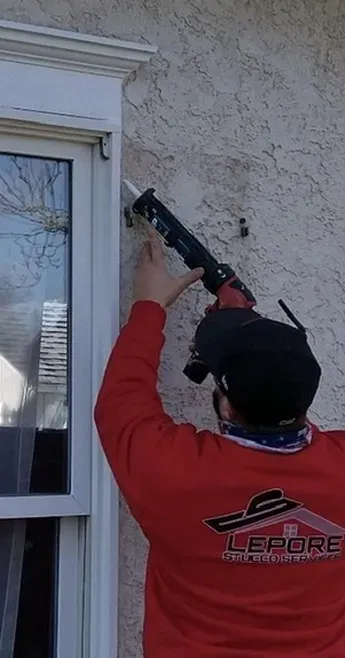
Comprehensive exterior caulking and sealing at windows, doors, and material transitions
Detailed flashing installation and correction, including kick-out and window pan flashing
Waterproofing and exterior painting to protect repaired areas long-term
Moisture diagnosis on fiber cement and vinyl siding, since water management principles apply beyond stucco and EIFS
Seasonal snow removal and ice control to help prevent weather-related damage around vulnerable transitions
Each project follows an inspection-driven scope: the company reviews existing moisture or stucco inspection reports, proposes a prioritized repair plan, and documents the work with daily photos so homeowners can see exactly what was done and why.
FAQ
Why does stucco fail in Delaware homes?
Stucco failure in Delaware homes rarely starts with the cladding itself. Missing, undersized, or improperly installed flashing at windows, doors, and roof intersections causes most water intrusion issues.
What is the difference between traditional stucco and EIFS?
Traditional hard-coat stucco is a durable layer of sand, lime, Portland cement, and water. EIFS is a synthetic system developed in Europe in the 1950s with different failure modes.
What should a Delaware moisture test include?
A proper Delaware moisture test targets real water intrusion sources, not surface stains. LePore Stucco Services LLC reviews stucco and moisture intrusion reports to develop a clear, cost-effective repair plan.
Conclusion
For Delaware homeowners in Wilmington, Hockessin, and Newark, the path to a dry, durable home begins with an accurate diagnosis that distinguishes traditional stucco from EIFS and targets the real source of water intrusion, faulty flashing, not the cladding surface. A professional moisture test and inspection provide the roadmap for surgical, cost-effective repairs that stop damage without unnecessary demolition. Homeowners who act on this knowledge protect their investment and avoid repeated failures.
Comments